
ROUSSANOU
Roussanou is the sixth track on RICHELE’S second EP, Eladia UNDER HER MUSICAL MONIKER, HELE.
A R T I S T ‘ S N O T E S
by Hele
IT’S INTRIGUING WHAT WE TURN TO when our mood is low. Most people watch comedies or romances to lift their spirits. Less sensibly, I binge tragedies. The darker, the better—Manchester By the Sea, Never Let Me Go, The Road. I also read poetry that seems archly designed to eviscerate the reader. What is it about this self-imposed catharsis so deliberately aimed at our emotional prow? And why does it make us feel better, even as it sinks us further?
One poem that usually does the trick for me is Philip Larkin’s, An Arundel Tomb:
“Time has transfigured them into
Untruth. The stone fidelity
They hardly meant has come to be
Their final blazon, and to prove
Our almost-instinct almost true:
What will survive of us is love.”
Deep in the nexus of the pandemic winter, I found Larkin’s final line: “What Will Survive of Us (is love)” so perfectly gut-wrenching, I hijacked it to use as the track’s working title. But as winter marched on, the song changed its mind (as they do), and Czesław Miłosz’s wistful poem, Encounter stepped into the ring:
“That was long ago. Today neither of them is alive,
Not the hare, nor the man who made the gesture.
O my love, where are they, where are they going
The flash of a hand, streak of movement, rustle of pebbles.
I ask not out of sorrow, but in wonder.”
And so, for a time the track became, Not the Hare, Nor the Man.
Until 2022, when we traveled to Meteora, Greece and cycled through the mountains to visit a spate of monasteries and nunneries still balanced on towering peaks. My favorite was Roussanou, a convent set on a monolith of sandstone in striated pinks and yellows, inhabited by Orthodox nuns.
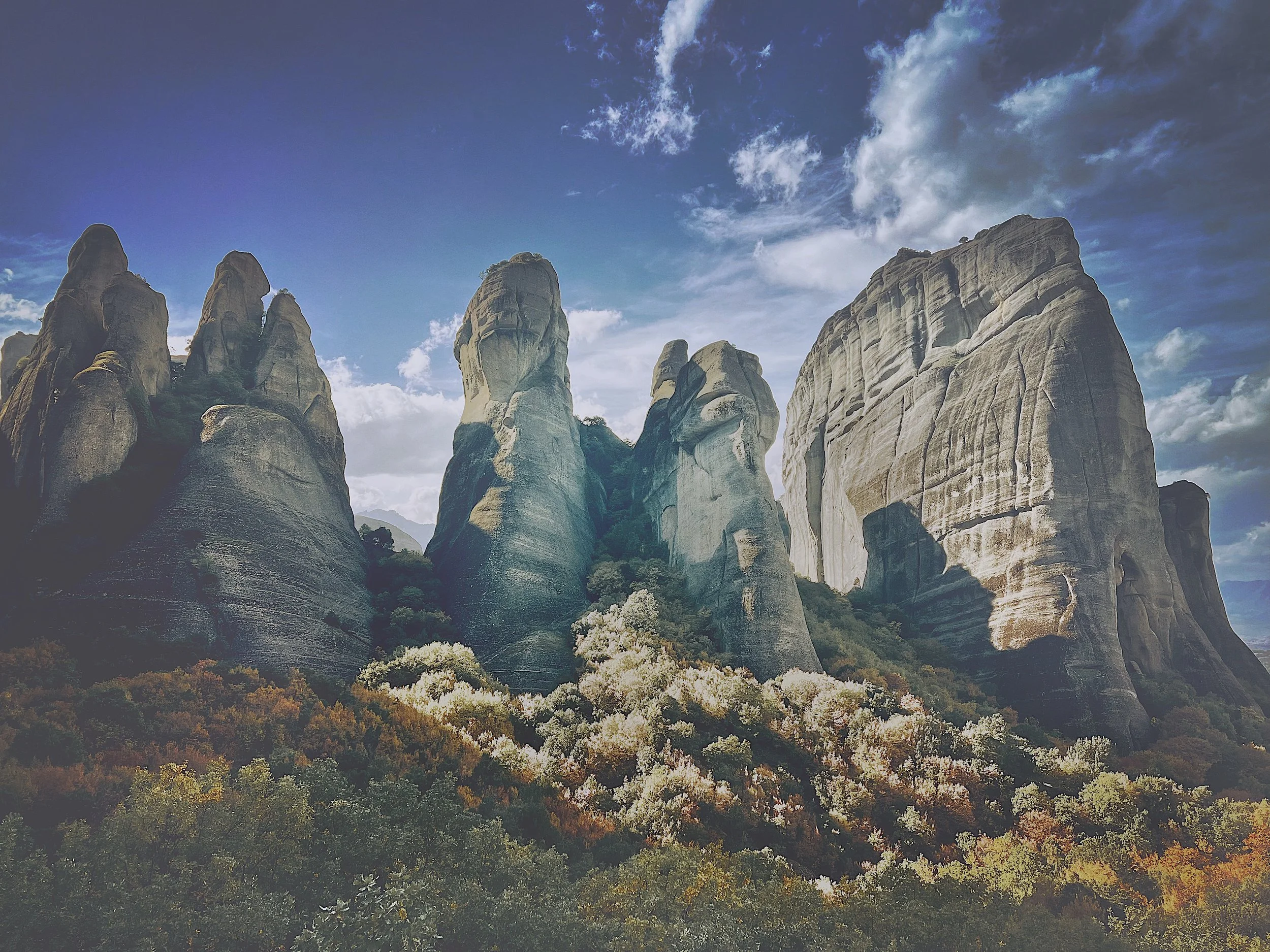
Biking through Meteora, Greece should be on everyone’s bucket list, btw. | 2022
Wandering the grounds, I caught sight of one sister who was notably young and fresh-faced. She moved effortlessly through the halls, trailing a luminous energy as golden as the sunshine that streamed in the convent windows. In her gray shift with her russet hair tied back, she could have stepped from a Renaissance painting. A girl with the sensibilities of a nun but the hidden vitality of an artist.
When I first wrote the string-heavy Roussanou, it felt to me a bit like—bear with me—what a pop song would sound like if it was performed by Vivaldi’s figlie di coro in 1716.
The figlie di coro, or “daughters of the choir”, was a group of girls and women who both inspired and performed Vivaldi’s work. Many of them were orphans who suffered from disease and disfigurement, and thus, wards of La Pietà—a Venetian convent. There, they were raised beneath the rigorous tutelage of the Pietà nuns where they became virtuosos of every instrument and excelled academically. However, even their astonishing talents weren’t enough to grant them acceptance in respectable society. Whenever they performed, they were wholly obscured by a curtain, ostensibly too “unsightly” to be gazed upon directly by their audiences.
Sometimes when I am sad, my thoughts drift to the figlie di coro, at once adored and rejected by their audiences and the world, at large. The cruel irony of it seems infinitely unjust.
But then, my mind’s eye conjours the visage of that clear-eyed, young novice polishing the candelabras and lighting the votives in Roussanou’s halls. The one with purpose in her presence. I hear the flames snap and flicker; feel the corridor radiating peace all around her. And I am reminded that both grief and joy can inhabit the same room. Sure, some days only sadness will do. But no matter how good it hurts, it’s wise to remember: despair is not the only game in town.
+
P R O D U C E R ‘ S N O T E S
by Andy Dollerson
Modular synth is my favourite instrument for creating glitchy sounds that kind of straddle ground—not really landing solidly in either the tonal melodic, or percussive rhythmic camp. The clicky arpeggiated sound all over this piece is created from that, with a bit of extra processing in Ableton. I pushed it in and out of reverb, which made it move from the background of the song to the foreground at certain points. I close mic’ed a snare drum and tapped out a rhythm with my fingers, and a synth-dust-removal brush, and layered it with the field recordings and digital kit to humanise the rhythm a bit more.
+