
Santu Antine
SANTU ANTINE is the FOURTH track on RICHELE’S second EP, Eladia UNDER HER MUSICAL MONIKER, HELE.
A R T I S T ‘ S N O T E S
by Hele
THE SOURCE OF SONGS IS ARCANE. They alight from moments, dreams, the shifting worlds around us. Titles are another matter; they’re fickle and ever-changing as the sky, darting from idea to idea until they attach, furtively to finished songs.
I wrote Santu Antine long before I journeyed to it in real life. In 2021, the working title of the track was, Oceanmouth, shorthand for the landscape that dominated my dreams at the time of the writing—a cerulean seascape ringed by coves and towering rocks, and an interior of hills and valleys filled with high, gold grasses. I had no idea that this place was here on earth.
Then, in 2023, on a trip to Sardinia, an island off the coast of Italy, I landed on the doorstep of one of the world’s oldest cultures: The Nuragic Civilization.
A Bronze Age people who settled Sardinia from 1800 BC to 800 BC, the Nuragic people were warriors, farmers, and herders. They were devout and ritualistic, bound to their religion before all else. Their sites once numbered 10,000, but only about 3,000 can be found today. We chose to visit Santu Antine on the plains of Cabu Abbas, a three-story complex oriented to follow the solstices, a sanctuary of triangular corridors and helical stairs crafted from stacked basalt stones. Historians consider it to be one of the most advanced dry-stone complexes on the planet.
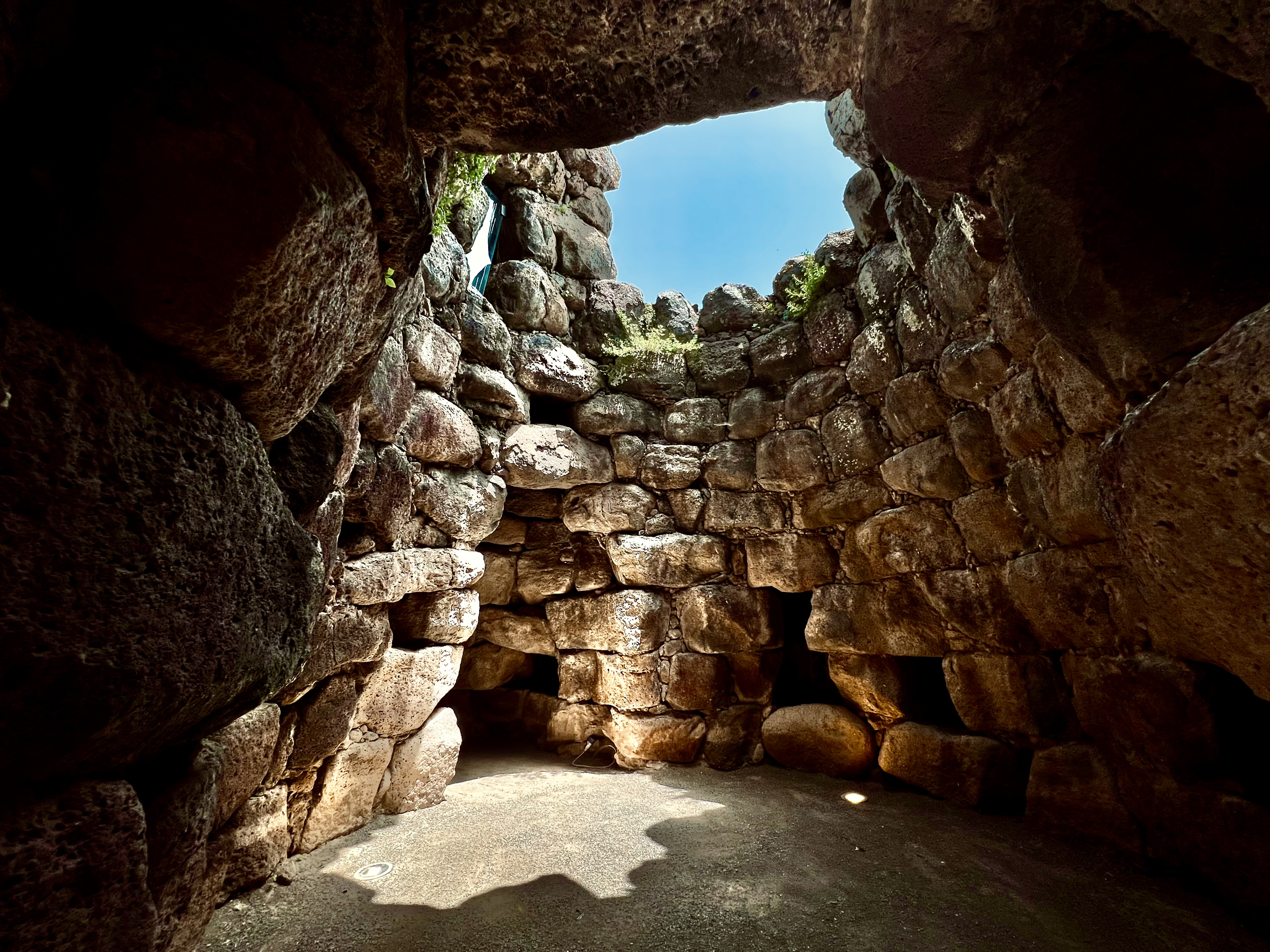
Nuraghe Santu Antine, Torralba, Sardinia | 2023
Even beyond its astonishing, archaeoastronomical construction, Santu Antine is striking in its simple steadfastness. After 3000 years, it still stands, with a sort of quiet confidence, in a field. Across the road, a Nuragic-themed café sells sandwiches and guidebooks; shrewd Torrealbans making a good living off the fortitude of their ancestors.
While I was in Castelsardo, in the north, I purchased a Nuragic pendant with a peculiar design—a human in downward flight, arms at their sides.
This was the “inverted figure”, I learned. A person traveling from life to death, diving from earth into the underworld. The resonance of this symbol is that death is not a thing to be feared but a new adventure.
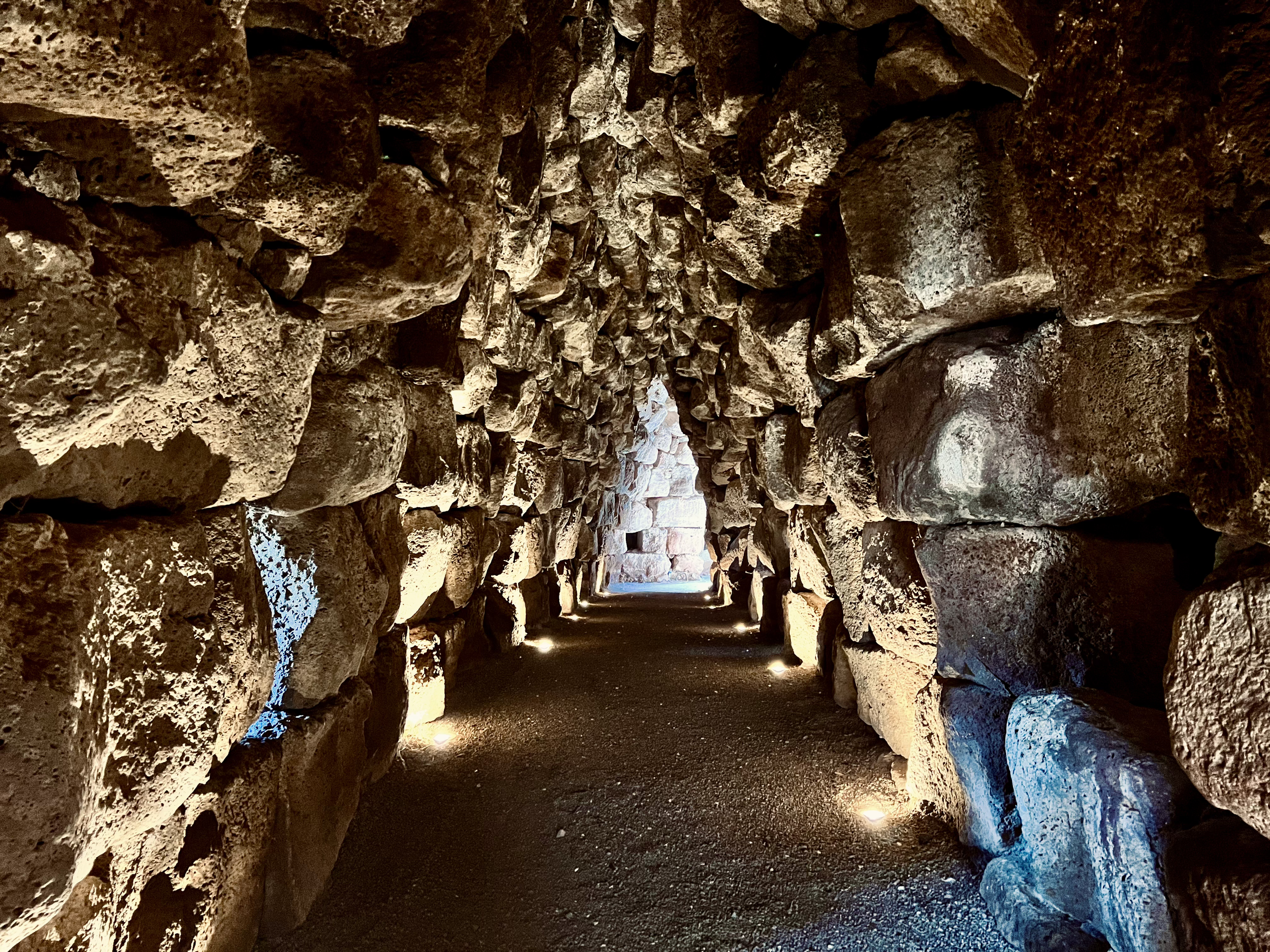
Nuraghe Santu Antine, Torralba, Sardinia | 2023

Across the island in Dorgali, we visited the “giant’s tombs”—large burial chambers marked by massive, arched rocks. The Nuragic people believed in the transformation of their deceased loved ones into gods and preternaturally large heroes.
A few months ago, I dreamed of Naki, a childhood friend who passed away in recent years. She walked towards me through a crowd, growing larger with every step. By the time she reached me, she was eleven feet tall and glowing like a meteor.
“You’re so big!” I cried, as we clasped each other’s hands.
“It’s all relative,” she replied, shrugging.
And together, we flew onward.
+
P R O D U C E R ‘ S N O T E S
by Andy Dollerson
On this album, as with Richele’s first one, the strings are the headline, so one of my aims was to make sure that the ear is drawn to the movement of the strings before anything else, and then, after a few listens other more subtle elements would start to emerge.
I particularly love subtle rhythmic movements off the slow drum grooves, by manipulating the field recordings, or glitchy fills in the percussion around the groove. I think it keeps the listener interested even if it’s not consciously heard.
Richele likes that too, so we had fun scattering those elements throughout the music.
My background and degree are in electroacoustic music composition, and the beginning of this track was a good excuse to stretch those muscles a bit by sound designing a musical canvas to begin the piece off.
There was a lot of time stretching of the recordings of the violin—from the low, gritty sound, to the high chirping sound. They were all stretched and warped from the original violin recordings and then bathed in some lush reverb.
The working title of this track was related to the ocean, and while I was digging into it, I tried to bring some reflections of the ocean into my production. I used quite a lot of sidechaining on this song—I wanted to reflect the rhythm of the ocean, albeit in a sped-up way, but sidechaining gives a slow ‘pumping’ rhythm, especially to the synth pads in the bigger moments of the piece. You can hear the pumping effect well at the end of the piece, just before the final string moments. I also tried to create a splashy effect with the higher percussion using shorter reverbs, to give an impression of the crashing sound of waves.
+